

Bretton transformed weeks worth of discovery into one working session: a customer-specific agent, built with your team, in a day
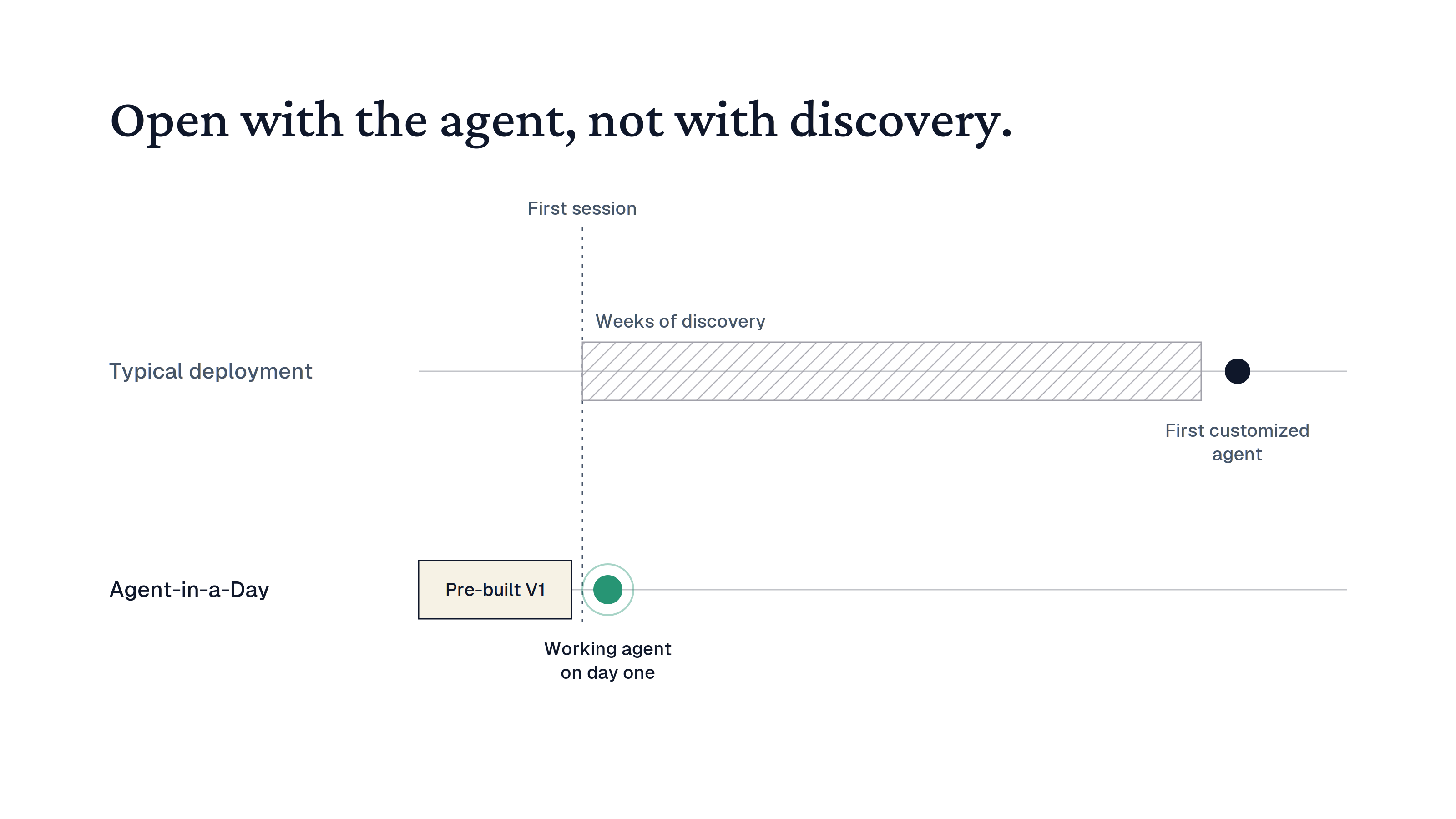
Most enterprise AI projects spend weeks in discovery before anyone sees anything customized to your environment. Bretton’s Agent-in-a-Day inverts that. We go onsite with your team, start from your actual workflow and policies, and configure working agents using the capabilities already built into the Bretton AI platform. The goal is to get to a working, customer-specific agent created quickly enough that your team can shape it directly and leave with a clear path to production.
Start with a pre-built V1
Before the onsite, we collect the materials that define how the work is done today: SOPs and risk procedures, representative historical cases, raw case inputs, expected outputs, decision rules, terminology, and the systems involved. That lets us pre-build a strong first version of the agent before the session starts.
Our session does not open with discovery, it opens by showing customers an agent we already built. Day 1 becomes feedback and iteration instead of alignment, which is where the most time is usually lost.
Configure it live with the people who own the work
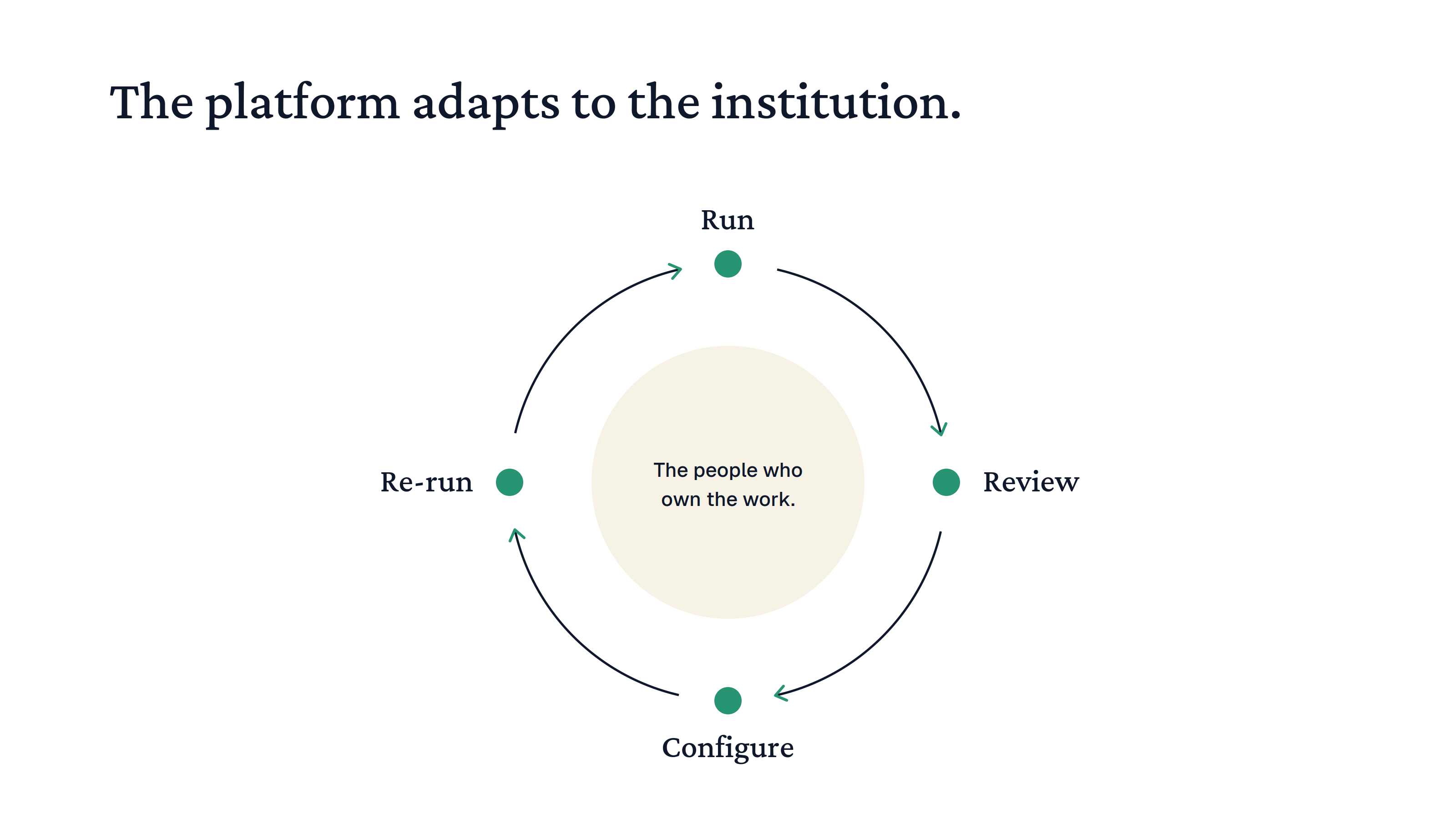
During this working session, we run the agent against representative cases and review the output with the people who own the process. They tell us what should change: maybe the narrative needs a different structure, maybe the team uses different terminology, maybe a new skill is required. We make the change and run again. Run, review, configure, re-run. That loop is the core structure of the day, and it shows how quickly the platform adapts to the way your team actually works.
The speed comes from not starting from scratch. Bretton AI already provides reusable capabilities for entity research, document and transaction analysis, ownership research, screening, registry lookup, evidence handling, and structured outputs. Agent-in-a-Day is about configuring those capabilities around your policies and workflow, which is what lets us move fast without forcing every customer through the same generic process.
Configuring to your workflow means more than producing a plausible answer. A useful agent reflects how your institution wants the work done: the required checks, the order of operations, the risk logic, the dispositions, the escalation rules, the output format, and the language your analysts use. In prior onsites we have matched exact review formats and risk logic, built new skills live, and adapted outputs to local-language and regional requirements. That is what the session is really proving: the platform adapts to the institution, not the other way around.
Separate integration from proving the workflow
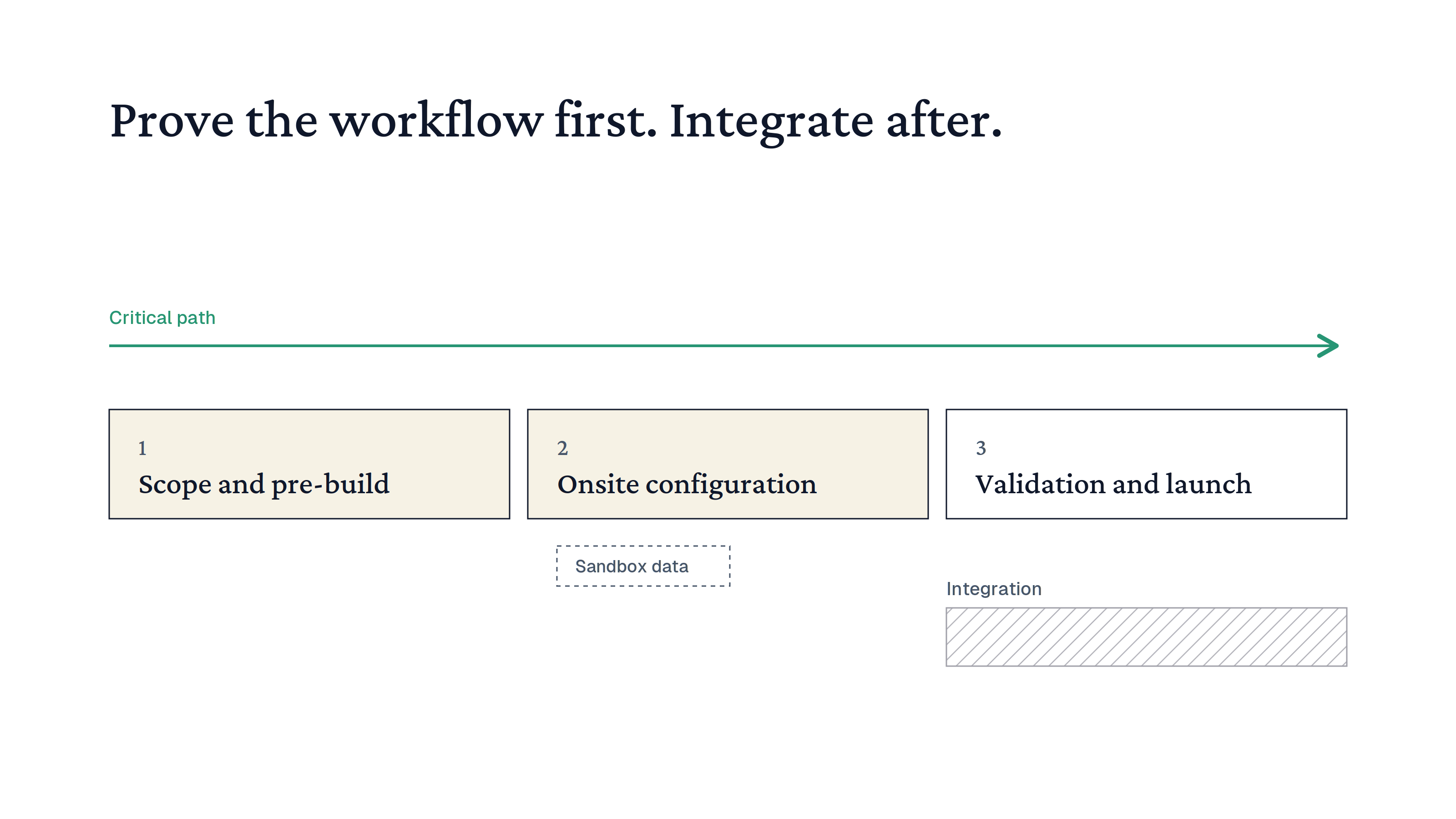
Integration is often the longest part of a deployment, as we explored in this blog, so we take it off the critical path. The functional workflow can be built and tested in the Bretton AI sandbox using sanitized, cloned, or synthetic data, which lets the onsite focus on the questions that actually matter: does the agent follow the process, does it produce the right output, does it reflect the institution's policies, and can it be tuned quickly? Integration then becomes part of the validation and deployment phase rather than a prerequisite for proving the workflow. The sequence is deliberate: scope and pre-build, onsite configuration, then validation and launch.
What you leave with
After Agent-in-a-Day, you leave with a working first version, outputs aligned to your standards, a known list of tuning items, agreed validation criteria, a clear integration plan, and a defined path to production. From there the remaining work is focused: broader validation, final tuning, integration, QA, and production readiness.
That is the whole design. Compress weeks of abstract discovery into a working session with the people who know the process best. Build quickly with the team that owns the work, prove the agent can match the institution, then take it through final tuning and integration to production.
If your team would like to try an Agent-in-a-Day with us, please reach out!
AI agents for the financial back office
Bretton builds AI agents for the back office of banks and financial institutions — compliance review, investigations and the operational work that still scales with headcount. Payward, the parent company of Kraken, uses Bretton to clear high-risk cases with full quality control instead of hiring against the backlog.