A U.S. bank with more than $200 billion in assets now runs enhanced due diligence on its payments clients as one investigation across three Bretton AI agents.
Bretton AI agents can now hand off work to each other. A workflow links agents in order. When one agent's case reaches an outcome, that outcome starts the next agent, and the next agent receives everything the earlier step produced.
Many reviews take more than one pass. An EDD review leads to a request for information (RFI), then a final decision. A transaction monitoring alert moves from L1 to L2, then to a SAR decision. Until now, each pass was a separate case, and an analyst had to open the next case and carry over what the last reviewer found. With Workflows, the whole review runs as one investigation. The first bank using it runs EDD on the fintechs it banks.
What's new
- Agents pass work forward. When a step finishes, the next agent receives the earlier step's documents, findings, narrative, outcome and analyst notes. The next agent checks that work against the data in its own case and builds on it.
- Each outcome picks the next step. "Escalate to L2" can start the L2 agent. "Request info" can start an RFI agent. "Close" ends the investigation.
- Analysts confirm every hand-off. By default, a step completes when an analyst confirms its outcome. The next agent starts only after that.
- Every step belongs to one investigation. Each step's case links to the same investigation, so a reviewer or examiner can follow the review from the first alert to the final decision, even when the steps run days apart.
- Analysts track runs in one place. The Workflows page shows each investigation and the step it has reached.
How a $200 billion-plus bank runs payments EDD with Workflows
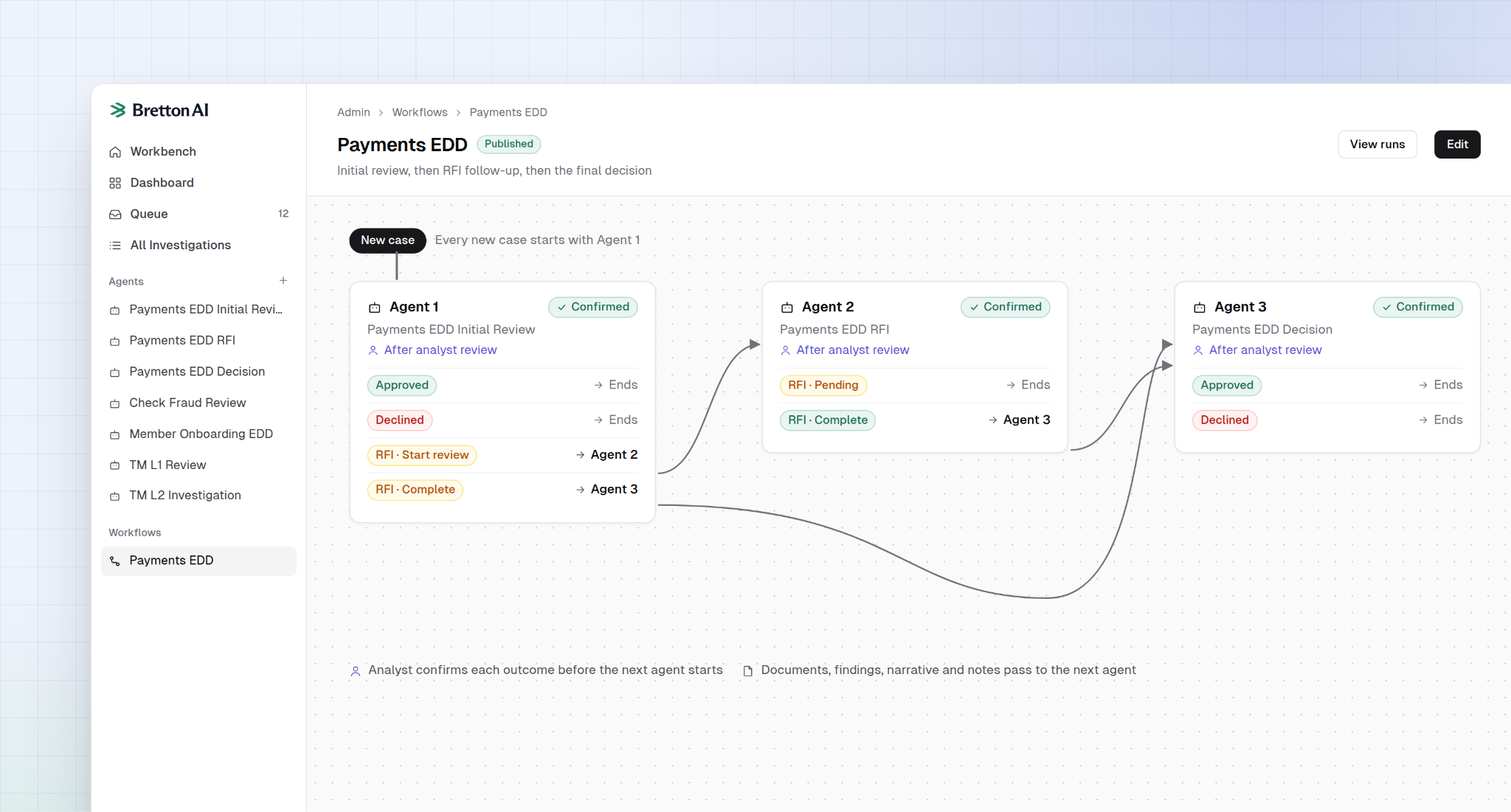
The bank reviews each fintech client in three steps, with one agent per step. A bank analyst reviews each agent's outcome before the case moves on:
- Agent 1, initial review: reviews the business relationship, account activity and flow of funds, and recommends approving, declining or requesting more information. An approval or decline closes the investigation. A request for information sends the case to Agent 2, or straight to Agent 3 if the customer has already responded.
- Agent 2, RFI follow-up: reviews the customer's response alongside Agent 1's findings. Once the response is complete, the case moves to Agent 3.
- Agent 3, final decision: recommends approving or declining the customer, using the work from both earlier steps, and produces the documents the bank needs for its file.
Before Workflows, the bank's analysts handled each review as three separate cases and linked them by hand. Now an analyst who opens the final decision sees the initial review, the RFI follow-up and the notes from each step in the same investigation. Other customers already run workflows of their own: a fintech sponsor bank chains its transaction monitoring reviews, and a major crypto exchange runs its EDD reviews as workflows. The same structure fits any review with more than one stage, such as a transaction monitoring alert that moves from L1 review to L2 investigation to a SAR decision.
AI agents for the financial back office
Bretton builds AI agents for the back office of banks and financial institutions — compliance review, investigations and the operational work that still scales with headcount. Payward, the parent company of Kraken, uses Bretton to clear high-risk cases with full quality control instead of hiring against the backlog.